
The 8-Day Kyrgyzstan Itinerary: The Health-Smart Song-Kol and Tien Shan Version

The standard Kyrgyzstan trip drives you from Bishkek at roughly 800 m straight over the Kalmak-Ashuu pass at 3,446 m to a Song-Kol yurt camp at about 3,013 m in a single day. That is a sleeping-altitude gain of more than 2,000 m, and CDC notes that with rapid ascent profiles like this, rates of altitude illness approach 50%. This 8-day version breaks the drive with a night in Kochkor at 1,767 m, puts two nights at Song-Kol instead of one, and treats Tash Rabat at 3,200 m as a day trip with a lower sleeping altitude. Most travelers on this route should discuss acetazolamide with a provider, since CDC describes the standard prophylactic dose as 125 mg every 12 hours starting the day before ascent.
Most Kyrgyzstan itineraries you will find online run Bishkek to Song-Kol in a single day. It is a beautiful drive and it is the wrong altitude profile. You leave a city at roughly 800 m, cross the Kalmak-Ashuu pass at 3,446 m, and go to sleep in a felt yurt at about 3,013 m with no road out until sunrise. As a PA who has seen what a bad first night at elevation does to a trip, I plan this one differently. The eight days below buy you a night in Kochkor, a second night at the lake, and a Tash Rabat visit that does not cost you a high sleeping altitude.
Who this itinerary is for
This is a first trip to Central Asia for someone who wants nomadic summer pasture life and Tien Shan scale without a technical trek. You do not need mountaineering experience. You need to tolerate long gravel-road days, basic yurt sanitation, and sleeping at 3,000 m for two nights. Fitness helps with enjoyment but does not protect you from altitude illness. CDC is explicit that training and physical fitness do not affect risk, and that a traveler's sex plays a minimal role, if any, in determining predisposition.
Returning travelers who have already done Issyk-Kul or Karakol can compress days 1 and 2 and add a third night at Song-Kol or a Kel-Suu extension south of Naryn. Anyone with unstable cardiac or pulmonary disease, poorly controlled seizure disorder, or severe sleep apnea should read the health prep section before booking, and should have this conversation with a physician rather than a tour operator.
The route
Kyrgyzstan's road network fans south from Bishkek, so almost every itinerary is a loop or an out-and-back on the same two corridors. This one runs south down the Kochkor valley, west over the Kalmak-Ashuu pass to Song-Kol, south again over the Moldo-Ashuu side to Naryn, and then a day trip further south to Tash Rabat before turning around.
The elevation shape matters more than the mileage. You start at about 800 m in Bishkek, touch high ground on a day hike in Ala-Archa National Park where the terrain climbs from roughly 1,500 m at the entrance toward peaks near 4,895 m, then step up to a 1,767 m sleeping altitude at Kochkor. From Kochkor you cross 3,446 m at the pass and settle at about 3,013 m at Song-Kol for two nights. You then drop to Naryn at roughly 2,000 m, take Tash Rabat at 3,200 m as a day visit, and sleep low again before the transfer north.
That shape is the whole point. The Wilderness Medical Society guidance quoted by CDC recommends avoiding ascent to a sleeping altitude of 2,750 m or higher in a single day, ascending no more than 500 m per night in sleeping altitude once above 3,000 m, and allowing an extra night for every 1,000 m of sleeping altitude gain. No practical Song-Kol itinerary fully satisfies that on a gravel road with one pass. This one gets as close as the geography allows and covers the gap with pacing and, for many travelers, medication.

Day-by-day plan
Day 1: Arrive Bishkek, sleep low
Manas airport receives most flights in the small hours. Do not schedule anything for the afternoon. Bishkek at roughly 800 m is functionally a low-altitude city, which makes it a useful place to recover from the flight before you ask anything of your body. Walk Ala-Too square, eat, and drink more water than feels necessary. CDC advises avoiding alcohol for the first 48 hours at high altitude, and starting that habit a day early costs you nothing.
Day 2: Ala-Archa National Park, high day and low night
Forty minutes south of the city, the Ala-Archa gorge opens into a glacial valley where the park rises from about 1,500 m at the entrance to 4,895 m at Semenov-Tian-Shansky Peak. Walk up toward the Ak-Sai valley as far as your legs and the weather allow, then come back down and sleep in Bishkek.
This is a health decision disguised as a hike. CDC notes that hypoxemia is greatest during sleep, and that day trips to high-altitude destinations with an evening return to a lower altitude are much less stressful on the body. You get the ventilatory stimulus without the overnight cost.
Day 3: Bishkek to Kochkor via Burana
Four to five hours south, with a stop at the Burana Tower, the surviving minaret of the medieval town of Balasagun. You arrive in Kochkor, a low-slung market town at 1,767 m, and sleep in a family guesthouse.
Most operators skip this night. It is the single highest-value change you can make to a Kyrgyzstan itinerary. It converts a 2,200 m single-day sleeping gain into two steps of roughly 950 m and 1,250 m. If you and your provider decided acetazolamide fits your profile, this is typically the day it starts, since CDC describes the regimen as beginning the day before ascent.
Day 4: Kalmak-Ashuu pass to Song-Kol
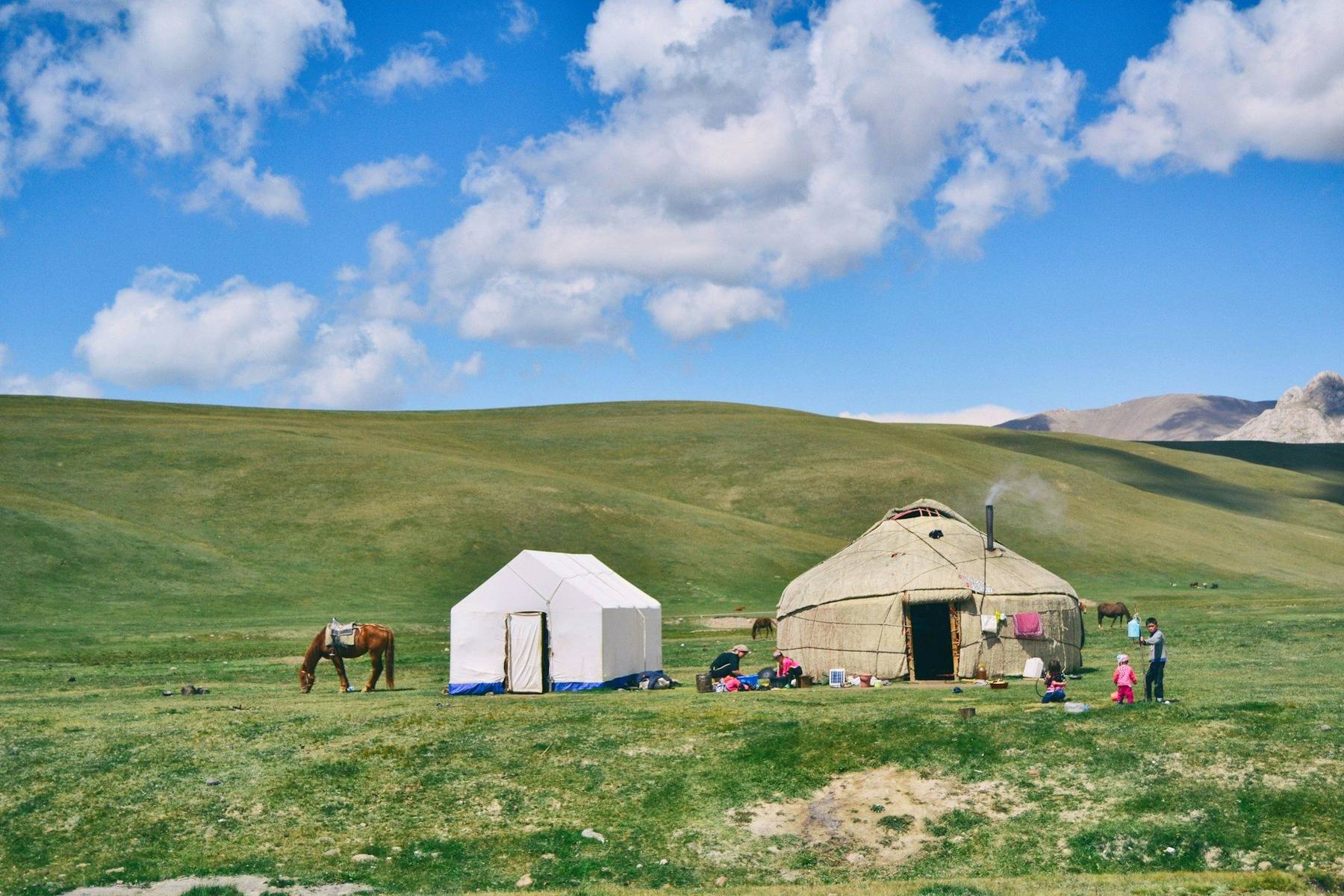
The gravel road climbs in tight switchbacks to the Kalmak-Ashuu pass at 3,446 m, then drops onto the Song-Kol basin at about 3,013 m. The lake sits in a bowl of summer pasture with no trees, no permanent buildings, and hundreds of yurts pitched for the grazing season.
Arrive, then do almost nothing. CDC advises only mild exercise for the first 48 hours at altitude. Walk the shoreline, take the photographs, eat a light dinner. Symptom onset for acute mountain sickness is usually 2 to 12 hours after arrival at a higher elevation, and often during or after the first night, so what you feel at midnight is more informative than what you feel at 4 pm.
Want the health prep for Kyrgyzstan?
Get a 60-second pre-trip check: the vaccines, prescriptions, and altitude/seasonality notes that change the plan — built for your exact dates.
Day 5: Song-Kol, horses and the jailoo
This is the day the trip is for. Ride out across the jailoo with a herder, or walk the northern shore if you would rather stay on your own feet. Song-Kol has been a summer pasture for centuries and remains a working landscape rather than a staged one.
It is also the day where the eating decisions matter. Herder families are generous and the generosity often arrives as unpasteurized dairy. Surveillance published in Microorganisms in 2022 recorded human brucellosis incidence of 45.6 per 100,000 in Naryn province across 2010 to 2020, with Kyrgyzstan's highest recorded national figure around 80 cases per 100,000 in 2011. Boiled milk tea, cooked mains, and bread are a different risk category from fresh kymyz and homemade cream. Declining politely is a normal thing that travelers do here.

Day 6: Song-Kol down to Naryn
Leave the basin over the southern pass, past Sary-Bulak where the Song-Kol road meets the Naryn highway, and descend to the Naryn river valley at about 2,000 m. Naryn is a Soviet-planned town strung along the river, and after two nights in a yurt the hot shower is not a minor detail.
The descent is doing clinical work as well. CDC notes that AMS improves rapidly with a descent of 300 m or more, especially if exertion is minimal, and that travelers with AMS generally improve within 12 to 48 hours if they do not ascend further. Dropping 1,000 m on day 6 means anything mild that started at the lake has somewhere to resolve.
Day 7: Tash Rabat as a day trip
Tash Rabat sits 110 km south of Naryn, a stone caravanserai from the 14th century built into a side valley at about 3,200 m. Walk the ridge above it for the view down the valley toward the Torugart corridor, then drive back down and sleep in Naryn.
Plenty of itineraries put a yurt night at Tash Rabat. By day 7 you have banked enough acclimatization that a night there would likely be fine for most travelers, but the day-trip version costs you nothing and gives you a second low night before a long transfer. When the high thing and the low night are both available, take both.
Day 8: Naryn to Bishkek and out
The long drive north retraces the Kochkor valley. Break it at the Kochkor felt-craft workshops or the Orto-Tokoy reservoir, arrive in Bishkek for a late meal, and head to Manas for a night departure.
Mountain roads in Kyrgyzstan are switchback-heavy and unpaved in stretches. Travelers who know they get motion sick should have a plan in place before the vehicle leaves, because most options work better taken ahead of symptoms rather than after.
Health prep for this trip
The Kyrgyzstan risk profile is unusual in a useful way. There is no malaria to plan around: WHO certified the country as having eliminated malaria in 2016, after Kyrgyzstan reported zero indigenous cases from 2011 onward. There is no yellow fever risk. What is left is altitude, food and water, and animal contact, and all three are manageable if you address them before you leave.
Altitude. CDC's risk table puts a first sleeping altitude between 2,750 m and 3,400 m in the medium category, and an ascent rate above 500 m per day over 3,000 m without extra acclimatization days in the high category. The standard Song-Kol run touches both. CDC's guidance for medium risk is that acetazolamide prophylaxis would be beneficial and should be considered; for high risk, that it should be strongly encouraged. The dose CDC describes is acetazolamide 125 mg every 12 hours, beginning the day before ascent and continuing the first two days at altitude. CDC also notes that acetazolamide compresses ventilatory acclimatization that normally takes 3 to 5 days into about one day. Whether it belongs in your kit is a provider conversation.
Headache and sleep. CDC reports that ibuprofen 600 mg every 8 hours helps prevent AMS, although not quite as effectively as acetazolamide, and lists it alongside acetaminophen for treating AMS symptoms. On sleep, CDC notes that above roughly 2,700 m some degree of periodic breathing becomes nearly universal and can interrupt sleep, that acetazolamide is effective for periodic breathing, and that respiratory depressants including alcohol and opiates should not be used to aid sleep at high altitude. If you normally rely on a sedating antihistamine such as hydroxyzine for sleep or itching, raise that specifically with your provider before a trip that puts you at 3,000 m for two nights, since sleep aids at altitude are not interchangeable.
Food and water. CDC reports traveler's diarrhea attack rates ranging from 30% to 70% of travelers over a two-week period depending on destination and season, and lists azithromycin 500 mg once daily for 3 days as a standard treatment regimen. Yurt camps draw water from streams and springs, so carry a filter or purification tablets and use them for drinking and tooth brushing. Untreated bacterial diarrhea usually runs 3 to 7 days per CDC, which on an 8-day itinerary is the whole trip.
Animals. Herder dogs at yurt camps are working animals, not pets. CDC bases rabies pre-exposure recommendations on animal rabies in the destination, availability of rabies biologics, intended activities especially in remote areas, and duration of stay, and the current schedule is two doses on days 0 and 7. Any bite or scratch means washing the wound immediately with copious soap and water and seeking post-exposure prophylaxis, whether or not you were vaccinated beforehand.
The Kyrgyzstan Tien Shan travel medicine bundle is built around this route, and the Kyrgyzstan destination guide covers the country-level health picture in more detail.
What to pack
- Water filter or purification tablets, plus a wide-mouth bottle you can actually treat in
- Your altitude plan as agreed with a provider, in original labeled packaging
- Ibuprofen, and oral rehydration salts
- A warm sleeping layer: Song-Kol yurts have stoves that go out overnight and the basin drops below freezing even in July
- Sun protection at strength. Two nights at 3,000 m of open pasture with no shade
- Headlamp. Yurt camps have no lighting once the generator stops
- Cash in som. There are no card terminals at Song-Kol or on the passes
- Sturdy shoes for the Ala-Archa hike and the Tash Rabat ridge
- A pulse oximeter if you want one. CDC notes travelers may want one to gauge acclimatization progress
Best time to go and what to avoid
Song-Kol is not a year-round destination. The road and the camps are both seasonal, and the pasture only holds nomad families for the grazing months.
Late June through early September is the reliable window. The health argument for the shoulder weeks in June and September is real: fewer people in a shared yurt means less crowding for whatever respiratory or gastrointestinal bug is circulating, and cooler ambient temperatures reduce food-handling risk. The argument against is cold. Overnight temperatures at 3,000 m fall below freezing in every month of the season, and poor sleep from cold compounds poor sleep from periodic breathing.
Cost expectations
Kyrgyzstan is among the more affordable mountain destinations in Asia. Yurt camp nights at Song-Kol including meals typically land in the modest range, guesthouses in Kochkor and Naryn are similar, and the dominant line item is the vehicle and driver, since public transport does not serve the Song-Kol passes. Budget realistically for a private car with a driver for days 3 through 8, and treat the travel health visit as a fixed pre-trip cost rather than an optional one. Prices move; check current rates when you book.
Day-by-day plan
| Day | What you're doing | Health note |
|---|---|---|
| 1 | Arrive Bishkek, sleep low Land at Manas, settle into central Bishkek at roughly 800 m and do nothing strenuous. | Sleep at low elevation on night one. Rehydrate after the flight and skip alcohol, which CDC advises avoiding for the first 48 hours at high altitude. |
| 2 | Ala-Archa day hike, back down to Bishkek Drive 40 minutes into Ala-Archa National Park and hike toward the Ak-Sai valley, then return to the city. | A high day with a low night is the least stressful way to touch elevation. CDC notes day trips to high altitude with an evening return to lower altitude are much less stressful on the body. |
| 3 | Bishkek to Kochkor via Burana Tower Cross the Shamsy valley, stop at the 11th-century Burana minaret, overnight in a Kochkor guesthouse at 1,767 m. | This is the acclimatization night most itineraries skip. If you and your provider have agreed on acetazolamide, today is typically when it starts, the day before ascent. |
| 4 | Over the Kalmak-Ashuu pass to Song-Kol Climb the gravel switchbacks to 3,446 m, drop to the Song-Kol shore at about 3,013 m, first night in a yurt. | Your sleeping altitude jumps roughly 1,250 m today. Walk the lakeshore, eat lightly, and do not ascend further if a headache appears. |
| 5 | Full day at Song-Kol, horses and jailoo Ride or walk the summer pasture, visit a herder family, second night at the lake. | The second night at the same elevation is the acclimatization. Decline unpasteurized dairy such as fresh kymyz, given brucellosis rates in Naryn province. |
| 6 | Song-Kol down to Naryn Descend the southern pass through Sary-Bulak to the Naryn river valley, overnight at about 2,000 m. | A recovery night 1,000 m lower. CDC notes AMS improves rapidly with a descent of 300 m or more, so this day doubles as your safety valve. |
| 7 | Tash Rabat day trip, sleep back in Naryn Drive 110 km south to the stone caravanserai at 3,200 m, walk the ridge above it, return to Naryn. | You visit 3,200 m with six days of acclimatization banked and still sleep at 2,000 m. That sequencing is deliberate. |
| 8 | Naryn to Bishkek and departure Long transfer north through the Kochkor valley, late meal in Bishkek, evening or overnight flight. | If motion sickness is an issue on Kyrgyz mountain roads, plan for it before you get in the vehicle rather than mid-switchback. |
Frequently Asked Questions
Many travelers on the standard route should at least discuss it. CDC places travelers whose first sleeping altitude is between 2,750 m and 3,400 m in a medium risk category, and travelers gaining more than 500 m of sleeping altitude per day above 3,000 m without extra acclimatization days in a high risk category. A Bishkek to Song-Kol run in one day hits both. CDC describes the standard prophylactic dose as acetazolamide 125 mg every 12 hours, beginning the day before ascent and continuing the first two days at altitude. Whether you need it is a conversation with a licensed provider, not a rule.
Yes, for some travelers. Song-Kol sits at roughly 3,013 m. CDC notes that acute mountain sickness affects about 25% of visitors sleeping above 2,450 m in Colorado, and that anyone unacclimatized proceeding to a sleeping altitude at or above 2,450 m is at risk. Symptoms usually appear 2 to 12 hours after arrival and often during or after the first night, which is exactly when most Song-Kol travelers are lying in a yurt with no easy way down until morning.
No. WHO certified Kyrgyzstan as having eliminated malaria in 2016, and the country reported zero indigenous cases from 2011 onward. Unlike Himalayan or East African trek itineraries, there is no antimalarial in the Kyrgyzstan kit. That frees the prep budget for the risks that actually apply here, which are altitude, food and water, and animal contact.
Cooked food served hot is generally the lower risk choice. The item worth declining is unpasteurized dairy. Peer-reviewed surveillance published in Microorganisms in 2022 recorded human brucellosis incidence of 45.6 per 100,000 in Naryn province between 2010 and 2020, and Kyrgyzstan's highest recorded national incidence was about 80 cases per 100,000 in 2011. Fresh kymyz, homemade cream, and raw milk cheeses are the classic exposure route. Boiled milk tea and cooked dishes are a different risk profile.
For this route, most travelers carry an altitude plan, a headache plan, and a gut plan. Acetazolamide if your provider agrees it fits your profile. Ibuprofen, which CDC notes at 600 mg every 8 hours helps prevent AMS, although not quite as effectively as acetazolamide. An antibiotic for traveler's diarrhea, since CDC reports TD attack rates of 30% to 70% of travelers over a two-week period. Water treatment, because yurt camps draw from streams and springs. Speak with a provider about what fits your history.
The season is short. The Kalmak-Ashuu pass is typically cleared by snow-blower at the end of May and closes with the first heavy snowfall in late October. Yurt camps populate the jailoo through the summer, with July and August the fullest months. Late June through early September is the window where the road, the camps, and the pasture life all overlap.
The Kalmak-Ashuu approach is a graded gravel road with tight switchbacks, and the Song-Kol to Naryn descent is similar. Travelers prone to motion sickness should treat it as a known variable rather than a surprise. Discuss options with a provider before departure, since most motion sickness medication works best taken before symptoms start, not after.
Talk to a physician familiar with high-altitude medicine before booking. CDC advises that travelers with sleep-disordered breathing planning high-altitude travel should receive acetazolamide, that those with severe obstructive sleep apnea should be advised to avoid high-altitude travel unless they receive supplemental oxygen in addition to CPAP, and that travelers with any form of chronic pulmonary disease or preexisting hypoxemia should consult a physician before this kind of trip. Song-Kol yurt camps have no power for a CPAP unit in most cases.
CDC gives travelers three rules: know the early symptoms, never ascend to sleep higher while symptomatic no matter how minor it seems, and descend if symptoms worsen despite rest or treatment at the same elevation. Practically, that means staying put at the lake rather than adding elevation, treating with a non-opiate analgesic, and going down toward Kochkor or Naryn if you are getting worse. CDC notes AMS improves rapidly with descent of 300 m or more. Ataxia, confusion, or breathlessness at rest are different problems and mean immediate descent and medical care.
It is worth raising with a provider if you will be around herder dogs at yurt camps or in remote valleys where prompt care is hours away. CDC bases pre-exposure recommendations on animal rabies in the destination, availability of rabies biologics, intended activities in remote areas, and duration of stay. The current schedule is two doses, day 0 and day 7. Regardless of vaccination, any bite or scratch means washing the wound immediately with copious soap and water and seeking post-exposure prophylaxis.
Mark Karam, PA-C is a board-certified Physician Associate with emergency and urgent care experience and co-founder of Wandr Health.