
The 8-Day Komodo and Flores Itinerary: The Health-Smart Version

An 8-day Komodo and Flores itinerary runs Denpasar to Labuan Bajo, a 3-day liveaboard through Komodo National Park, then an overland leg across central Flores to Kelimutu's three-colored crater lakes. The health-defining moment happens on day 2: Bali carries no malaria risk, but Labuan Bajo and the rest of East Nusa Tenggara sit inside CDC's year-round malaria zone, so the flight between them is also a chemoprophylaxis boundary that most standard Bali-plus- Komodo trip plans miss. CDC also puts Indonesia's two-week traveler's diarrhea attack rate at 30 to 70 percent, and the liveaboard days put open-water motion sickness on the daily schedule rather than as an occasional risk. A licensed clinician should confirm your specific antimalarial and dosing before you fly.
Komodo National Park gets sold as a bucket-list dragon sighting, and it is one, but almost nothing about getting there or moving through it happens on land. This itinerary crosses a real malaria boundary on day two, spends three days on a liveaboard where open-water crossings are the daily routine rather than a single ferry ride, and ends on the opposite side of Flores at Kelimutu's crater lakes. The health planning here isn't a checklist bolted onto a generic Indonesia trip, it follows the actual geography of where the risk changes and when.
Who this itinerary is for
This suits travelers who want wildlife and diving-grade snorkeling more than beach lounging, and who are comfortable with several consecutive days on small boats. If you've done a liveaboard or multi-day sailing trip before, the Komodo National Park leg will feel familiar, cramped cabins, early starts, and a schedule built around tide and light rather than convenience.
First-timers to Indonesia should know this route is not the Bali beach week some travelers expect when they hear "Indonesia." Labuan Bajo is a small, developing gateway town, healthcare access thins out fast once you're on Flores' interior roads, and the malaria conversation is real here in a way it isn't for a standard Bali itinerary. Our Indonesia destination guide covers the country's broader, very uneven health geography if you're combining this with a Bali stop.
Returning divers and trekkers will recognize the pattern: a boat-heavy first half, a road-heavy second half, and a single-day summit hike at the end. What's specific to this route is the mid-trip crossing from a malaria-free island into a malaria-risk province, a detail that a lot of combined Bali-and-Komodo trip plans miss entirely, since most itineraries built around Bali alone never need to think about it.
Families and travelers with young children should weigh the liveaboard portion carefully. Cabin space is tight, decks are wet, and the komodo dragon trek requires the ability to stay close to a ranger and move quickly if instructed. This itinerary is written for adults and older kids comfortable with several consecutive active days rather than a relaxed island-hopping pace.
The route
Almost every US traveler reaches Komodo through Denpasar, Bali's international gateway, since there's no direct international service into Labuan Bajo. From Denpasar, a short domestic flight covers the roughly 320 nautical miles east to Labuan Bajo, the small port town that serves as the launch point for Komodo National Park.
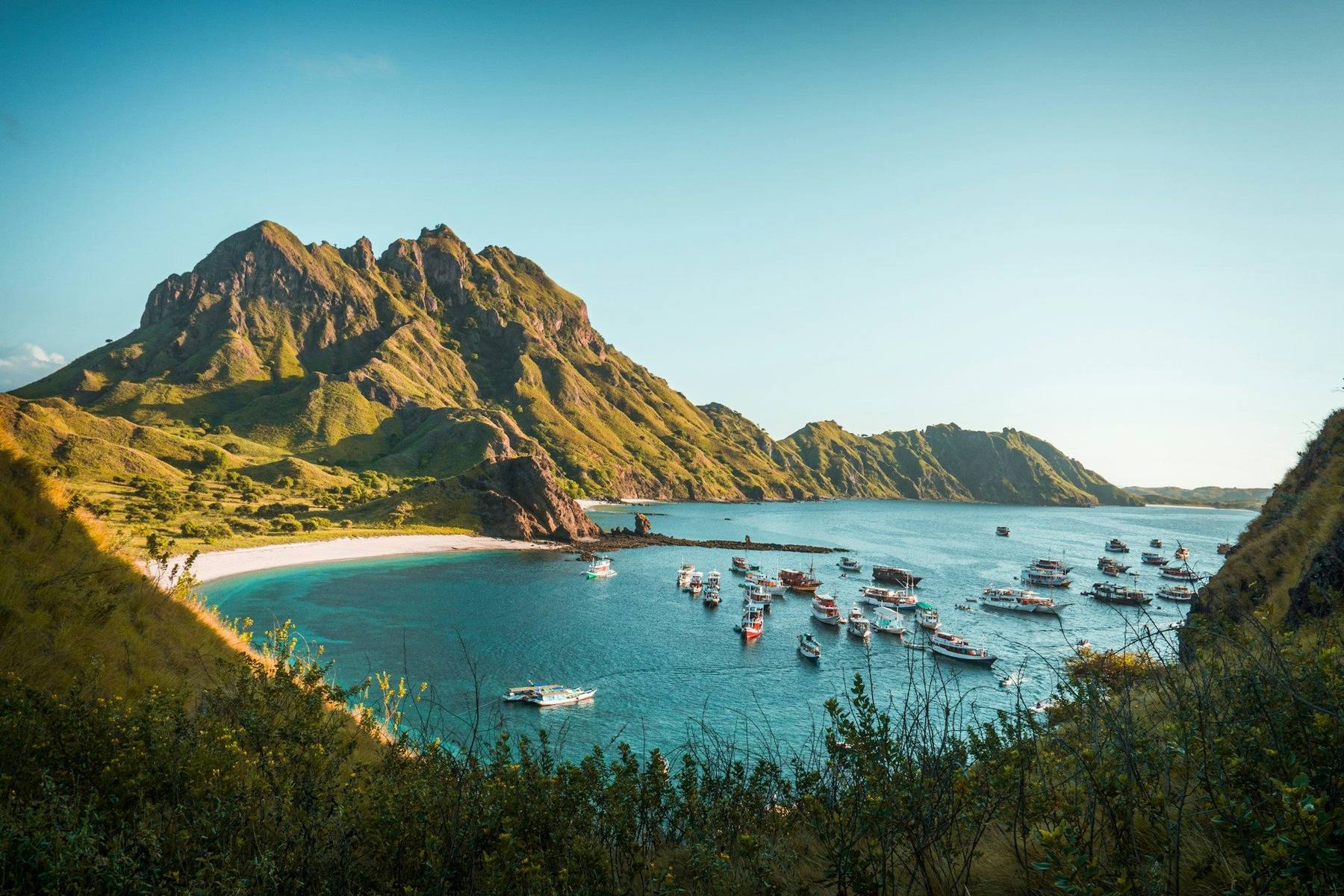
From Labuan Bajo, a three-day liveaboard covers the park itself: Padar Island's saddle viewpoint, Pink Beach, the ranger-led komodo dragon trek on Komodo Island itself (with a Rinca Island option for a second sighting), and snorkeling at Manta Point and Kanawa. The boat returns to Labuan Bajo harbor to close out the water portion of the trip.
The second half breaks from the coast entirely. A roughly three-hour mountain drive east reaches Ruteng in the Manggarai highlands, home to the striking Cancar spider-web rice fields, before continuing overland to Moni, the small village at the base of Kelimutu volcano. The trip ends with a pre-dawn hike to Kelimutu's rim for its three differently colored crater lakes, then a transfer out through Ende's regional airport.
Day-by-day plan
Day 1: Arrive Denpasar, Bali (no malaria risk here)
Land in Denpasar and spend the night near the airport or in Kuta or Seminyak before tomorrow's onward flight. Bali carries no malaria risk per CDC's country guidance, so this first night doesn't count toward antimalarial timing. If a clinician has you on atovaquone-proguanil, plan the 1-2 day lead-in around tomorrow's flight to Labuan Bajo, not around today's arrival in Bali.
Day 2: Fly to Labuan Bajo, cross into the malaria zone
A roughly 90-minute domestic flight takes you from Denpasar to Labuan Bajo, gateway to Komodo National Park. Settle into town and watch the sunset over the harbor, a genuinely spectacular one most evenings. This flight is the trip's real health-defining moment: Labuan Bajo and the rest of East Nusa Tenggara sit inside a year-round malaria risk zone per CDC, a sharp contrast to malaria-free Bali just 90 minutes behind you. Confirm your prophylaxis is already on board by the time you land, not something to start once you're here.
Day 3: Board the liveaboard, Padar Island and Pink Beach
Board your small liveaboard boat this morning. Most itineraries hike Padar Island's saddle viewpoint, one of the most photographed views in Indonesia, around sunrise or midday, then snorkel at Pink Beach on the way to the first overnight anchorage. Open-water crossings start today, and they're the defining physical feature of the next three days. Dose motion-sickness medication before boarding rather than after symptoms start, most travelers get more reliable protection that way across repeated short exposures than by treating symptoms as they appear.
Day 4: Komodo Island dragon trek, Rinca Island option
A ranger-led trek on Komodo Island is the centerpiece of the whole trip, ideally with an afternoon snorkel or a Rinca Island stop for a second, often closer dragon sighting. This is the one hazard on this itinerary that's genuinely specific to Flores: a komodo dragon bite carries a serious bacterial and hemotoxic wound risk, and while attacks on tourists are uncommon, they are documented. Stay with your ranger at all times, keep the required distance, and never approach or feed a dragon, park rules exist because of real incidents, not general caution.
Want the health prep for Indonesia?
Get a 60-second pre-trip check: the vaccines, prescriptions, and altitude/seasonality notes that change the plan — built for your exact dates.
Day 5: Manta Point and Kanawa, return to Labuan Bajo
A morning snorkel or dive at Manta Point is a strong final outing, followed by a stop at Kanawa Island's reef before sailing back into Labuan Bajo harbor to disembark by evening. This is your last full day of boat exposure on the trip. If conditions are choppier than the dry-season norm, plan your motion-sickness dose around the boarding time rather than waiting to see how the crossing feels.
Day 6: Drive to Ruteng, the Manggarai highlands
A roughly three-hour mountain drive east from Labuan Bajo reaches Ruteng, with stops at the Cancar spider-web rice fields and a Manggarai coffee farm along the way. You're still inside East Nusa Tenggara's malaria zone here, so prophylaxis continues on schedule even though you're on land instead of the boat now. The winding highland road is also a different motion-sickness trigger than the open-water crossings, worth a dose if you're prone to carsickness on switchbacks. Ruteng itself sits around 1,200 m, cool enough that evenings feel like a genuine break from Labuan Bajo's coastal heat.

Day 7: Overland to Moni, near Kelimutu
The drive continues east across central Flores to Moni, the small village at Kelimutu's base, a long day through highland villages and rice terraces. Traveler's diarrhea risk peaks on days like this one, small roadside warungs and home-style meals well off the main tourist circuit. CDC puts Indonesia's estimated two-week traveler's diarrhea attack rate at 30 to 70 percent, and azithromycin is generally the preferred standby antibiotic for Southeast Asia because regional Campylobacter strains are frequently resistant to older fluoroquinolone antibiotics. Stick to bottled or treated water and freshly cooked, hot food.
Day 8: Kelimutu sunrise, transfer out via Ende
A pre-dawn hike to Kelimutu's rim rewards early risers with sunrise over its three differently colored crater lakes, a sight that shifts shade over months and years for reasons still debated by geologists. From Moni, transfer to Ende's regional airport for a flight back to Denpasar or Jakarta. Kelimutu's summit sits around 1,640 m, well under the roughly 2,500 m mark where CDC's Yellow Book says acute mountain sickness becomes a meaningful risk, so this is a fitness note rather than an altitude-medication day. Once you leave East Nusa Tenggara, continue antimalarial prophylaxis for its full course, most regimens require about a week of follow-through after your last exposure in a risk area.
Health prep for this trip
Start the conversation with a licensed clinician 4 to 6 weeks out. This itinerary bundles three separate, genuinely distinct decisions: malaria prophylaxis for the Komodo and Flores legs, a motion-sickness plan built for repeated short boat exposures rather than one long crossing, and a traveler's diarrhea standby for a route that spends real time off the main tourist track. Given confirmed chloroquine-resistant P. falciparum and P. vivax in Indonesia, atovaquone-proguanil is a commonly recommended option, and its dosing schedule (starting 1-2 days before entering a risk area and continuing for 7 days after leaving) should be planned around your Denpasar-to-Labuan Bajo flight specifically, not your overall departure date. Fill an azithromycin standby prescription before you go, and pack meclizine dosed for pre-boarding use rather than as a rescue medication. Routine vaccines and, depending on how rural your route gets, rabies pre-exposure vaccination are worth discussing given Indonesia's ongoing rabies circulation in dogs and other mammals. Our Komodo and Flores travel medicine kit is built around this exact route, and our atovaquone-proguanil, meclizine, and azithromycin pages cover what a clinician will walk through with you.
What to pack
A dry bag is non-negotiable for the liveaboard days, spray and the occasional wave are part of small-boat travel in the park. Bring reef-safe sunscreen (standard sunscreen is restricted or discouraged around some of Komodo's reef sites), a light long-sleeve layer for sun and bug protection on deck, and real trekking shoes with grip for both the Komodo Island ranger trek and the pre-dawn Kelimutu hike. A basic travel-medicine kit covering malaria prevention, motion sickness, and digestive upset is worth having on hand for the full trip, and a headlamp earns its keep on day 8's early start.
Best time to go and what to avoid
Most travelers should avoid scheduling the liveaboard days during the December-through-March west monsoon window if flexibility allows, since rougher seas both increase motion-sickness risk and raise the odds of an itinerary change if a crossing gets cancelled for safety. Malaria and traveler's diarrhea risk don't follow a tight seasonal pattern the way the swell does, so mosquito-bite prevention and food and water precautions matter on this route regardless of when you go.
Cost expectations
Budget for a multi-day liveaboard package (the single largest line item on this trip), Komodo National Park entrance and ranger fees, and a private driver or organized tour for the overland Ruteng-to-Moni leg, since public transport options thin out fast once you're off the main Labuan Bajo road. Most travelers should expect this to run as a mid-range adventure trip rather than a budget backpacking stop, largely because of the liveaboard cost and the domestic flights connecting Denpasar, Labuan Bajo, and Ende. Factor in a buffer day around the liveaboard disembarkation as well, boat schedules shift with weather and tides, and a tight same-day connection into the Ruteng drive can turn a delay into a missed overland transfer.
Beyond the liveaboard and domestic flights, day-to-day costs on Flores itself run modest by Southeast Asia standards: guesthouses, warungs, and a private driver for the overland legs are all reasonably priced compared to Bali's tourist zones. The biggest budget variable most travelers underestimate is the liveaboard tier itself, boats range from basic shared-cabin trips to dive-focused vessels with private rooms, and that single choice moves the overall cost of this itinerary more than any other decision on the route.
Day-by-day plan
| Day | What you're doing | Health note |
|---|---|---|
| 1 | Arrive Denpasar, Bali (no malaria risk here) Land in Denpasar, the international gateway most US travelers connect through since there is no direct international service into Labuan Bajo. Overnight near the airport or in Kuta/Seminyak. | Bali carries no malaria risk per CDC guidance, so this night doesn't count toward your antimalarial timing. If you're taking atovaquone-proguanil, most travelers start it 1-2 days before entering a risk area, plan that lead-in around tomorrow's flight, not today's arrival. |
| 2 | Fly to Labuan Bajo, cross into the malaria zone A roughly 90-minute domestic flight takes you from Denpasar to Labuan Bajo, gateway to Komodo National Park. Settle in, sunset drinks over the harbor. | This flight is the trip's real health boundary. Labuan Bajo and the rest of East Nusa Tenggara sit inside CDC's year-round malaria risk zone, while Bali does not. Confirm your prophylaxis is already on board by the time you land. |
| 3 | Board the liveaboard, Padar Island and Pink Beach Board a small liveaboard boat. Sunrise or midday hike up Padar Island's saddle viewpoint, then snorkel at Pink Beach on the way to your first overnight anchorage. | Open-water crossings start today. Dose motion-sickness medication before boarding, not after symptoms start, most travelers get more consistent protection that way for repeated short boat exposures. |
| 4 | Komodo Island dragon trek, Rinca Island option Ranger-led trek on Komodo Island to see wild komodo dragons, with an afternoon snorkel or a Rinca Island add-on for a second, usually closer dragon sighting. | Komodo dragons are the one Flores-specific hazard nothing else in this itinerary covers. Stay with your ranger, keep the recommended distance, and never approach or feed a dragon, a bite carries a serious bacterial and hemotoxic wound risk that needs urgent evaluation. |
| 5 | Manta Point and Kanawa, return to Labuan Bajo Morning snorkel or dive at Manta Point, a stop at Kanawa Island's reef, then sail back into Labuan Bajo harbor to disembark by evening. | Your last full day of boat exposure. If the crossing back is choppier, especially outside the April-October dry season, plan your motion-sickness dose around the boarding time, not the forecast. |
| 6 | Drive to Ruteng, the Manggarai highlands A roughly 3-hour mountain drive east from Labuan Bajo to Ruteng, stopping at the Cancar spider-web rice fields and a Manggarai coffee farm. | You're still inside the malaria zone, prophylaxis continues on schedule regardless of being on land now instead of the boat. The winding highland road is also a second, different motion-sickness trigger than the boat days, worth timing a dose if you're prone to carsickness. |
| 7 | Overland to Moni, near Kelimutu Continue east across central Flores to Moni, the small village at the base of Kelimutu volcano. A long driving day through highland villages and rice terraces. | Traveler's diarrhea risk is highest on days like this one, small warungs and home-cooked meals off the main tourist track. Stick to bottled or treated water and freshly cooked, hot food. |
| 8 | Kelimutu sunrise, transfer out via Ende Pre-dawn hike to Kelimutu's rim to watch sunrise over its three differently colored crater lakes, then transfer to Ende airport for a flight back to Denpasar or Jakarta. | Kelimutu's summit sits around 1,640 m, well under the roughly 2,500 m threshold where CDC's Yellow Book says acute mountain sickness becomes a meaningful risk, so this is a fitness note, not an altitude-medication day. Once you leave East Nusa Tenggara, continue antimalarial prophylaxis for the full course, most regimens require about a week of follow-through after your last exposure. |
Frequently Asked Questions
Generally yes. CDC places Komodo, Flores, and the rest of East Nusa Tenggara inside a year-round malaria risk zone, distinct from Bali and Jakarta, which carry no malaria risk. Given confirmed chloroquine-resistant P. falciparum and P. vivax in Indonesia, options like atovaquone-proguanil are commonly recommended. A licensed clinician should confirm the specific regimen and dosing based on your itinerary and medical history.
Bali itself carries no malaria risk per CDC guidance, but that doesn't cover the rest of a Bali-plus-Komodo trip. The moment you fly from Denpasar to Labuan Bajo, you cross into East Nusa Tenggara's malaria zone, so prophylaxis timing should key off that flight, not your overall trip start date.
Most of this itinerary happens on the water, multi-day liveaboard legs and repeated open-water crossings between islands, which puts motion sickness on the daily schedule rather than as an occasional risk. Medications like meclizine are generally dosed before boarding rather than after symptoms start, which matters for a route built around several distinct short boat exposures.
Wild komodo dragons are large predators with a bite that carries a real bacterial and hemotoxic wound risk, and attacks on humans, while uncommon, do happen. Park rules require a ranger escort on every trek, a minimum safe distance, and no feeding or approaching, rules that exist because of documented incidents, not just caution.
High. CDC lists Indonesia among destinations with an estimated two-week traveler's diarrhea attack rate of 30 to 70 percent. Azithromycin is generally the preferred standby antibiotic for Southeast Asia specifically because regional Campylobacter strains are frequently resistant to older fluoroquinolone antibiotics.
The dry season, roughly April through October, generally brings calmer seas and better visibility for the boat-heavy days this itinerary depends on. The November through March west monsoon brings rougher Flores Sea crossings, which is worth factoring in if you're prone to motion sickness.
Not for direct travel from the US. CDC lists yellow fever vaccination as an entry requirement only for travelers arriving from a country with risk of yellow fever transmission, which doesn't apply to a standard US-to-Indonesia itinerary.
Yes, rabies circulates in dogs and other mammals across Indonesia, including rural Flores. If you're bitten or scratched by any animal, wash the wound with soap and running water for a full 15 minutes and seek medical care the same day regardless of any prior vaccination. Healthcare access is limited outside Labuan Bajo and Ende, which is one more reason travel insurance with medical evacuation coverage is worth having on a route like this one.
The Wandr Team is the editorial group at Wandr Health; every article is reviewed by a licensed clinician before publication.